Seventy-Seven Men on a Village Green
On the morning of April 19, 1775, somewhere between 77 and 80 colonial militiamen stood on Lexington Green and watched approximately 700 British regulars advance toward them. The engagement that followed lasted a matter of minutes. When it ended, eight colonists were dead and ten wounded. The British column continued its march toward Concord.
The first day of the Revolutionary War produced no American paintings, no official sketches, no commissioned record of any kind. The men who were there were occupied with surviving it. The documentary impulse — the understanding that this particular morning needed to be fixed in images — came later, and from an unlikely quarter.
Eight months after Lexington and Concord, in December 1775, a twenty-one-year-old silversmith's apprentice from New Haven published four copper-plate engravings of the battles. They remain, to this day, the only contemporary American visual record of April 19, 1775. Amos Doolittle had not been there. He went back.
The Man Who Engraved His Own Body Into History
Doolittle was born in Cheshire, Connecticut, in May 1754 — self-taught as an engraver, trained as a silversmith, and twenty years old when the war began. In spring 1775 he enlisted in the Connecticut militia, serving under Captain Benedict Arnold in the Governor's Second Company of Foot Guards. His company marched to Cambridge, arriving around April 29 — ten days after the battles, early enough for the ground still to mean something.
He obtained leave and traveled to Lexington and Concord with Ralph Earl, a self-taught portrait painter working in New Haven. Earl made drawings on site, interviewed witnesses, and rendered the scenes in four paintings. Doolittle engraved them. The Connecticut Journal advertised the set on December 13, 1775: "neatly engraven on Copper, from original Paintings taken on the Spot." Six shillings for the plain set; eight shillings hand-colored.
What the advertisement did not mention was the method. Earl directed Doolittle to pose — "in such a position," holding a musket — so the military figures could be rendered with anatomical accuracy. Doolittle stood in for the soldiers he was depicting. The figures of Colonel Smith and Major Pitcairn in the prints are, in part, Doolittle's own body, traced and transferred to copper. He placed himself, physically, into the historical record he was constructing.
Four Plates, One Morning
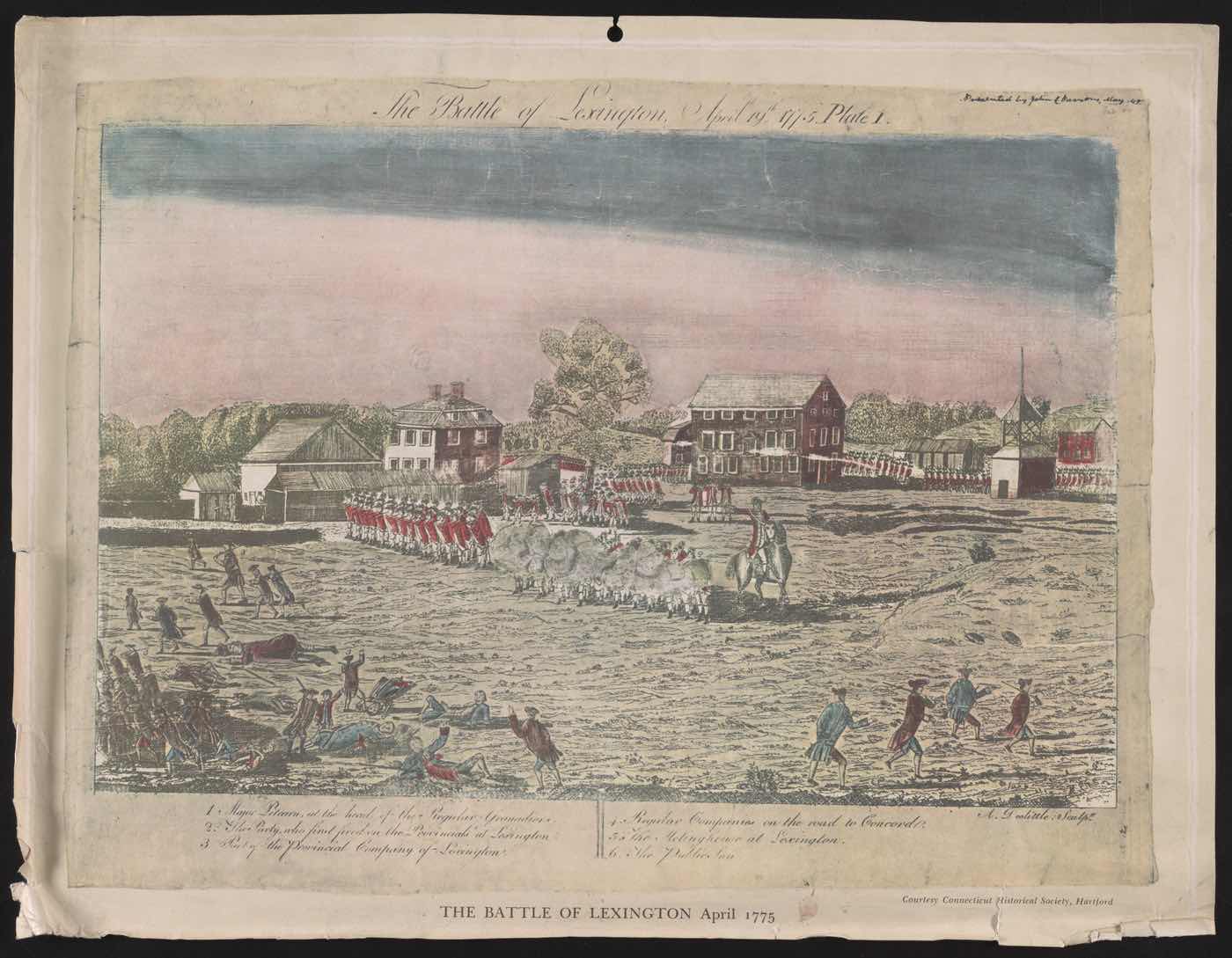
Plate I shows Lexington Green: Major John Pitcairn on horseback, British regulars arrayed in formation, Captain Parker's 77 militiamen scattering across the green. The geometry of the scene is unambiguous. Whatever order was or was not given, whatever words were or were not shouted, the visual fact is plain — one side has closed ranks, the other is dispersing. Eight men would not leave the green alive.
Plate II moves to Concord: the British searching the town for colonial military stores, the church steeple visible against the sky, soldiers moving through a landscape that still looks, from a distance, like peacetime. The supplies they were sent to destroy were largely already gone.
Plate III records the North Bridge at Concord — the moment the colonial militia returned fire on British regulars in an organized engagement. Major John Buttrick is labeled in the print, the officer who gave the order. This is the hinge of the day: the first coordinated colonial counter-attack of the war. The "shot heard round the world," when Emerson eventually named it, was fired here.
Plate IV shows the retreat: General Percy's relief column of 1,000 men joining Lieutenant Colonel Smith's battered force, buildings burning along the road back toward Boston. The running fight that followed would cost the British 73 dead, 174 wounded, and 26 missing before they reached Charlestown. The four prints together form a coherent sequence — a single day, told in four frames, by a man reconstructing it from interviews and scorched ground.
The Loyalist Paradox
Ralph Earl, who made the original paintings from which Doolittle engraved, was a Loyalist. His family included committed patriots; Earl himself remained loyal to the Crown. He went to Lexington and Concord in May 1775, interviewed witnesses, sketched the terrain, and produced the four paintings that became the visual foundation for the only surviving contemporary American record of the battles. Then, in 1778, facing accusations about his political sympathies, he disguised himself as a servant to a British officer and fled to England. He left behind his wife and daughter.
In London, Earl studied under Benjamin West and developed into a skilled portrait painter. He returned to America in 1786, spent time in a New York debtor's prison, and eventually became a significant painter of Connecticut families. He died in 1801 in Bolton, Connecticut. The local reverend recorded the cause of death as "intemperance."
The historical irony has a certain compression to it. The patriot cause's most urgent visual document — the only images of the first day of armed resistance — was created from paintings made by a man who did not believe in that cause. The prints survived. Earl did not particularly thrive. The record outlasted its contradictions, as records tend to do.
The Shot Heard Round the World
The phrase that now defines April 19, 1775 was written sixty-two years after the fact. Ralph Waldo Emerson composed "Concord Hymn" for the completion of the Battle Monument; it was sung on July 4, 1837. Emerson had a direct connection to the ground — his grandfather, the Reverend William Emerson Sr., had watched the fighting at the North Bridge from his home at the Old Manse, a few hundred yards away.
"By the rude bridge that arched the flood, / Their flag to April's breeze unfurled, / Here once the embattled farmers stood, / And fired the shot heard round the world."
Ralph Waldo Emerson, "Concord Hymn," read at the completion of the Battle Monument, July 4, 1837The phrase was later inscribed on Daniel Chester French's Minute Man statue, dedicated in 1875. By then it had become the canonical description of the day. Doolittle's prints predate Emerson's poem by more than six decades. The engravings are the documentary image; the poem is the poetic echo. One was made from battlefield interviews and a silversmith's tools. The other was made from memory, sentiment, and a century's accumulated weight. Both are now part of the same story, though they arrived by entirely different routes.
Scarcity and Survival
The 1914 assessment by Beardsley described the Doolittle plates as "exceedingly crude in every way." He was not wrong about the technical execution. Doolittle was self-taught, working in a medium he had not mastered, on a compressed timeline, producing images of events he had not witnessed. The lines are sometimes stiff; the perspective occasionally uncertain. What the assessment misses is that the crudeness is also a kind of authenticity. These are not the polished commemorations of a settled nation looking back. They are a young man with a burin trying to fix something before it escaped entirely.
The prints were issued in limited numbers and have survived in limited numbers. Christie's January 2022 sale of an incomplete set — only two of the four plates — realized $750,000. Complete sets are rarer still. Estimates suggest fewer than ten full sets survive, along with four or five incomplete sets. The Connecticut Historical Society holds a hand-colored set donated in 1844, which it counts among its greatest treasures. The hand-colored versions — watercolor applied after printing, for the premium price of eight shillings — have a warmth the plain editions lack, the soldiers' coats rendered in red and blue, the sky pale above the green.
The 1903 Goodspeed reprints are what most people encounter in museum collections today. Accurate facsimiles, reasonably common, and not the same thing at all. The originals carry the specific weight of objects made close to the event — imperfect, urgent, and entirely irreplaceable.
What the Prints Are
Doolittle went on to a long career: maps for Jedediah Morse's American Geography in 1789, work on Mathew Carey's American Atlas in 1795 — the first general atlas of the United States — and enough engraving work over five decades to earn him the informal title "the Revere of Connecticut." He died in New Haven on January 30, 1832, at seventy-seven years old. The battles he had walked back to find in the spring of 1775 were, by then, the founding mythology of a country that had existed for half a century.
The four plates he produced at twenty-one remain the thing he made that matters most. Not because they are beautiful — Beardsley had a point — but because they are first. Before the paintings, before the monuments, before Emerson's verse fixed the language, there were four copper-plate engravings made by a young man who had not been there on April 19 and understood, somehow, that someone needed to go back and look.
Seventy-seven men on a village green. The fight lasted minutes. The images took eight months. They have lasted two hundred and fifty years.
Study the Doolittle Engravings
Heritage Lab's Witness to the Revolution study pack puts all four Doolittle plates in your hands, with a 20-page Educator Guide, investigation sheets, narration response pages, a timeline, vocabulary list, and standards alignment. Designed for Charlotte Mason picture study, homeschool history units, and classroom primary source analysis (grades 4-8). The scans are unrestored. The foxing, yellowing, and plate marks are original.
Available as an instant digital download on Etsy.
Engraving vs. Reality: What Doolittle Got Right and Wrong
Doolittle visited the battle sites within weeks and interviewed participants. But his engravings are interpretations, not photographs. Comparing the four plates to modern historical accounts reveals where eyewitness memory aligned with and diverged from what the documentary record now shows.
| Plate | What Doolittle Shows | What the Record Says |
|---|---|---|
| Plate I: Lexington | An orderly line of militia facing British regulars on the Green. The exchange appears almost formal. | Most accounts describe confusion. Parker's militia was dispersing when firing began. The "line" may reflect how participants later wanted to remember it. |
| Plate II: Concord | British troops searching houses in Concord center. Smoke rises from a fire at the courthouse. | Broadly accurate. The British did search buildings and set fires. The fire spread from military stores the British deliberately burned; it was not punitive destruction, but neither was it purely accidental. Doolittle's image does not clarify the distinction. |
| Plate III: North Bridge | The militia advancing in column toward the bridge. British regulars falling back in disorder. | The militia advance is confirmed. The British retreat was real but more controlled than Doolittle depicts. The engagement Emerson later called "the shot heard round the world" (in his 1837 Concord Hymn) occurred here. |
| Plate IV: The Retreat | British column under fire from behind walls and trees along the road to Boston. Individual militiamen firing from cover. | Highly accurate. The running battle from Concord to Charlestown is well documented. The guerrilla tactics Doolittle shows match multiple British and American accounts. |
Sources: Fischer, Paul Revere's Ride (1994); Gross, The Minutemen and Their World (1976). Plate analysis by Heritage Lab.
The value of Doolittle's engravings is not forensic accuracy. It is that they were made within weeks of the events, by someone who walked the ground and spoke to the men who fought. Where they diverge from the documentary record, they reveal how participants understood and reshaped their own experience almost immediately.