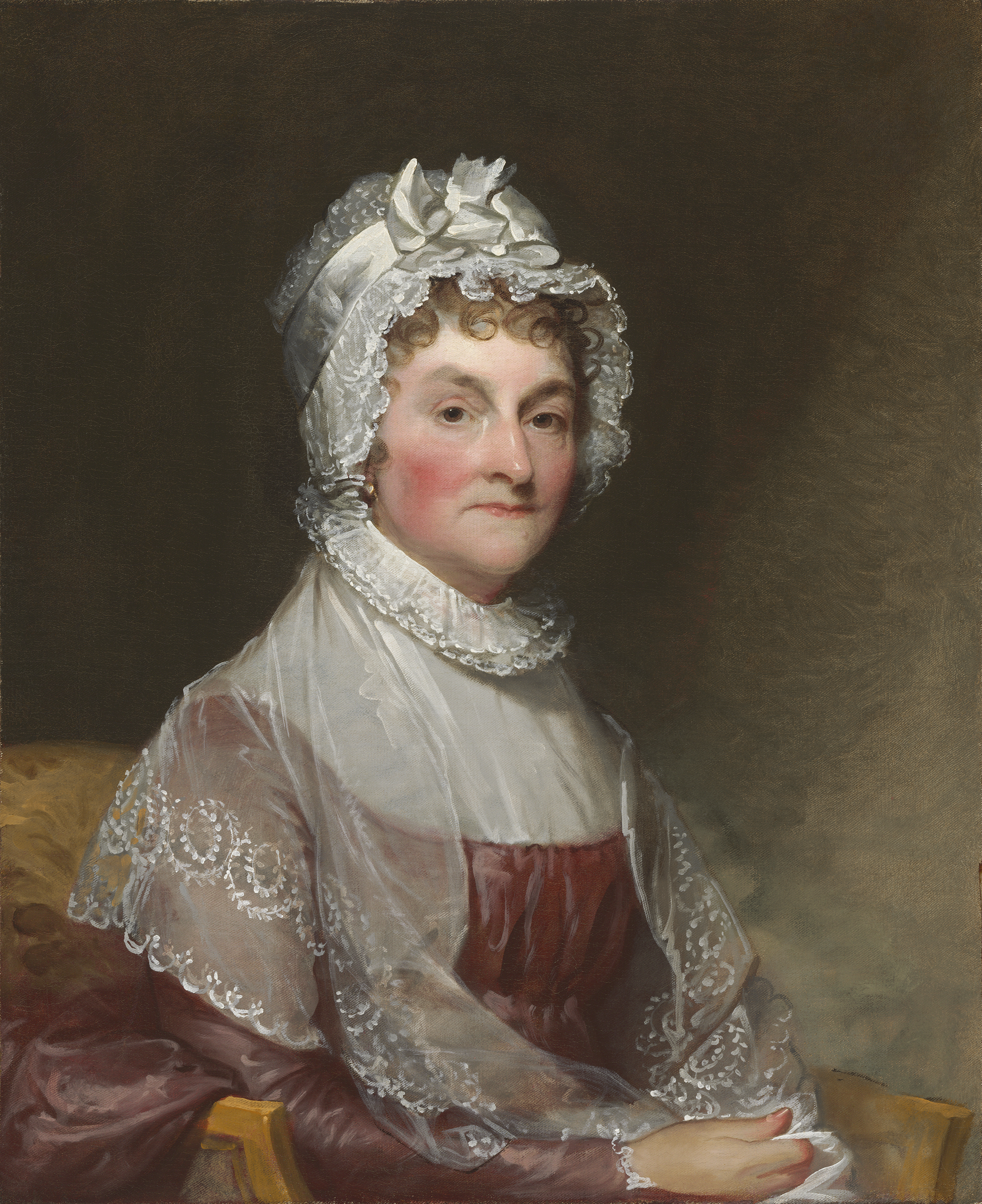
Abigail Adams Picture Study Kit
Portrait, narration prompts, investigation sheets, and educator guide for Charlotte Mason picture study and morning time. Instant digital download, $4.99.
View Study Kit on EtsyA Letter Written by Candlelight
On March 31, 1776, Abigail Adams sat in the parlor of the family house in Braintree, Massachusetts, and wrote to her husband in Philadelphia. John was at the Continental Congress, helping to build the legal framework for a country that did not yet exist. Abigail was managing a farm, raising four children, and watching the war from close enough to hear the cannon at Dorchester Heights. She had been inoculating the children against smallpox. She had been sheltering refugees from Boston. And in the middle of a letter filled with practical matters, crop prices and military news, she inserted one of the most quoted sentences in American political writing.
"Remember the Ladies, and be more generous and favourable to them than your ancestors."
Abigail Adams, letter to John Adams, March 31, 1776 (Adams Family Papers, Massachusetts Historical Society)John wrote back with a joke. He said he could not help but laugh. He assured her that men knew better than to give up the "Masculine system." The exchange has been quoted many times since. What is less often noted is that Abigail continued to advise him on policy, law, diplomacy, and military strategy for the next thirty years, and that he continued to listen.
What Gilbert Stuart Saw
Gilbert Stuart painted Abigail Adams around 1800 to 1815, when she was in her mid-fifties to early seventies. The portrait now hangs in the National Gallery of Art in Washington, D.C. Stuart was the foremost portrait painter in the early republic, responsible for the images of Washington, Jefferson, Madison, and Monroe that still define how those men appear in the national imagination. He painted Abigail with the same formal attention he gave any head of state, which tells you something about how she was regarded by those who knew her.
Look at the portrait. She is shown in a three-quarter view, wearing a white lace cap and a dark dress with a white fichu at the collar. The background is plain, dark, without ornament. Stuart's technique is visible in the handling of the face: the skin is built up in thin translucent glazes, warm over cool, so the cheekbones carry a subtle warmth while the temples recede into cooler shadow. The eyes are steady and direct. There is no sentimentality in the composition. Stuart painted her as he painted statesmen: with composure, intelligence, and a certain reserve that invites the viewer to look carefully before drawing conclusions.
Stuart left many of his portraits technically unfinished. His working method involved completing the face and leaving the costume and background in a looser state, sometimes returning to finish them, sometimes not. The Abigail Adams portrait has this quality. The lace of the cap is rendered with care, but the edges of the composition dissolve into broader, less resolved passages. This was Stuart's characteristic approach, not a sign of lesser regard. The face is where the painting lives, and the face is complete.
1,100 Letters and a Political Partnership
Abigail Adams was born Abigail Smith in 1744, in Weymouth, Massachusetts. She received no formal education. Women in colonial Massachusetts did not attend school. She was taught at home by her mother and her maternal grandmother, Elizabeth Quincy, and she read voraciously from her father's library: history, philosophy, theology, Shakespeare, Pope, and the political pamphlets circulating through New England in the years before the Revolution.
She married John Adams in 1764. Over the next four decades, they wrote more than 1,100 letters to each other, a correspondence now held by the Massachusetts Historical Society. The letters survive because both Abigail and John understood they were living through something that would need to be explained to future generations, and because their grandson Charles Francis Adams published a selection in 1840, preserving the collection's integrity for the generations that followed.
The letters reveal a political partnership of unusual depth. Abigail reported on troop movements, public opinion in Massachusetts, commodity prices, and the practical effects of congressional decisions on the people who had to live with them. She commented on the proposed legal code. She argued against slavery in terms that were plain and without qualification. She managed the family finances, invested in land, and kept the farm productive during John's long absences. When John was ambassador to Britain, she managed the household in London and navigated the complexities of court protocol with a mixture of republican conviction and social competence.
She was never a passive observer relaying news. She analyzed. She recommended. She disagreed. In a letter from 1775, she assessed the military readiness of the Massachusetts militia and the strategic significance of the heights around Boston with the specificity of someone who had studied the ground. She was, in practical terms, an unpaid and unacknowledged political advisor to a man who became the second President of the United States.
The Presidency and Braintree
John Adams served as Vice President under Washington from 1789 to 1797, and as President from 1797 to 1801. Abigail was in Philadelphia and later Washington for portions of both terms, though she spent considerable time in Braintree (later renamed Quincy), managing the property and corresponding at length. She was the first woman to live in the White House, moving in during November 1800, when the building was still unfinished. She famously hung laundry in the East Room because it was the only space large enough to dry clothes indoors.
Her letters from this period are characteristically direct about the state of the capital. The roads were mud. The house was cold. The walls were damp. She reported these conditions without complaint, as facts that needed attending to, in the same tone she used for everything else.
She died on October 28, 1818, at the age of seventy-three, from typhoid fever. John survived her by nearly eight years. Their son John Quincy Adams became the sixth President in 1825. Abigail did not live to see it, though she had predicted it with reasonable confidence in her letters.
A Portrait for Morning Time
Charlotte Mason's method of picture study asks children to look at an artwork carefully, in silence, for several minutes, and then describe what they have seen from memory. The purpose is not art criticism. It is sustained attention to a single image, followed by the effort of putting visual observation into words. The portrait of Abigail Adams is well suited to this practice because Stuart's technique rewards slow looking. The longer you study the face, the more you notice: the precise line where the shadow falls beneath the cheekbone, the way the lace cap frames her forehead, the quality of her gaze.
For morning time and morning basket work, the portrait serves as the anchor for a broader study that connects portraiture, letter writing, the Revolutionary period, and the question of what a historical record preserves and what it leaves out. Stuart's painting shows us what Abigail Adams looked like. Her letters show us what she thought. Both are primary sources. Neither is complete without the other.
Narration Prompts
- Describe the portrait from memory. What is Abigail Adams wearing? What expression does she have? What did the artist choose to include, and what did he leave out?
- Gilbert Stuart painted many of the Founding Fathers. Look at his portrait of George Washington and compare it to this one of Abigail Adams. What is similar about how Stuart approached these two subjects? What is different?
- Abigail Adams wrote "Remember the Ladies" in a letter to her husband while he was helping to write the laws for a new country. Why do you think she chose to put this in a letter rather than saying it in person?
- Abigail had no formal schooling but taught herself by reading from her father's library. Based on what you know about her letters, what kind of student do you think she was? What evidence supports your answer?
- If you could write a letter to Abigail Adams about something happening in your own community, what would you tell her about, and what question would you ask?
CC Cycle 3 Alignment
This portrait and study align with Classical Conversations Cycle 3, which covers American history from exploration through the modern era. The Adams correspondence supports Week 7 (Colonial Life) through Week 10 (The American Revolution), with particular relevance to the study of primary sources, the structure of the new government, and the roles individuals played outside formal political office. Abigail Adams also connects to the rhetoric strand: her letters are models of persuasive writing, structured argument, and the use of specific evidence to support a claim.
Morning Basket Suggestions
Display the Stuart portrait during morning time for one week. On the first day, practice a formal picture study: two to three minutes of silent observation, followed by narration. On subsequent days, read one letter excerpt aloud (the March 31, 1776 letter is the natural starting point, but the Massachusetts Historical Society has digitized the full correspondence). Pair the portrait with map work showing Braintree, Philadelphia, and the route between them. For older students, compare Abigail's account of the Battle of Bunker Hill with the account in your spine text. For younger students, the portrait and one letter are enough. Let the image do its work.
Letter writing is a natural companion activity. Ask each child to write a letter to someone they will not see that week, reporting on something that happened, something they observed, and one opinion. The format mirrors what Abigail Adams actually did, which is the point.
Study the Founding Portraits
Heritage Lab's Thirteen Portraits of the American Revolution educator pack includes Abigail Adams alongside Washington, Jefferson, Hamilton, Franklin, and eight other figures of the founding generation. Each portrait comes with an investigation sheet, narration prompts, and historical context designed for Charlotte Mason picture study, CC Cycle 3, and morning time integration. Thirteen portraits, one educator guide, ready to use. $4.99, instant digital download.
Charlotte Mason Picture Study: The Stuart Portrait
Gilbert Stuart's 1800 portrait of Abigail Adams is one of the few contemporary likenesses of the woman who advised presidents, advocated for women's education, and managed the Adams family's finances through decades of her husband's absence. For Charlotte Mason picture study, the portrait rewards close, sustained attention.
Narration Prompts
Show the portrait for several minutes without commentary. Then cover it and ask:
- Describe everything you remember about the woman in the portrait. What was she wearing? How was she sitting?
- What do you think she was thinking about when this was painted? What in the portrait gives you that impression?
- Stuart left this portrait unfinished. If you could see the parts he never painted, what do you think they would show?
- Compare this portrait to a photograph. What can a painted portrait show about a person that a photograph cannot?
- Abigail Adams wrote over 2,000 letters in her lifetime. If she were writing a letter right after sitting for this portrait, what might she say about the experience?
Key Attributes to Notice
| Attribute | What to Observe |
|---|---|
| Expression | Direct, composed gaze. Stuart was known for capturing psychological presence. Abigail's expression carries the assurance of someone accustomed to intellectual authority. |
| Unfinished State | Stuart left this portrait incomplete. The background and lower portions are underpainted. Stuart did this frequently, retaining portraits in his studio as "reference copies." The unfinished state is a feature of his working method, not a defect. |
| Color Palette | Muted warm tones. The pastel-like quality reflects Stuart's technique of building thin layers of oil paint. Compare to the bolder, darker palette of his Washington portraits. |
| Historical Context | Painted in 1800, when John Adams was president and Abigail was effectively co-governing from Philadelphia. She was 55 years old, had survived smallpox inoculation, managed a farm through a war, and raised a future president. |
Image: Gilbert Stuart, Abigail Smith Adams, c. 1800-1815. National Gallery of Art, Washington, D.C. Public domain.