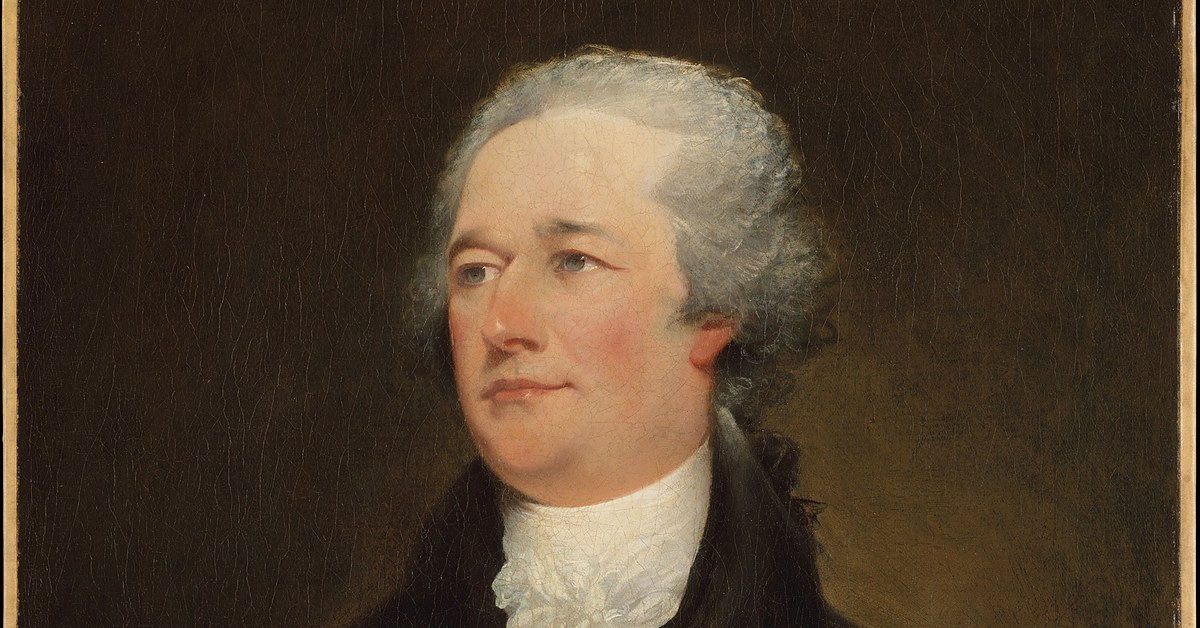
Alexander Hamilton Digital Portrait
High-resolution 8x10 digital download of Trumbull's 1792 Hamilton portrait. Print-ready at 300 DPI for morning time, picture study, or classroom display. $2.99.
Download on EtsyTwenty-Two Minutes in Trumbull's Studio
In 1792, John Trumbull painted Alexander Hamilton in his New York studio. Hamilton was thirty-seven years old. He had resigned as Secretary of the Treasury that January, exhausted by five years of building a national financial system from nothing, and was returning to his law practice at 57 Wall Street. Trumbull, who had served as an aide-de-camp during the Revolution and knew Hamilton personally, captured him in a three-quarter bust portrait against a plain dark ground. No props. No desk stacked with papers. No symbolic Republic in the background. Just the face.
It is the face of a man who has been working too hard for too long and knows he will not stop. The eyes are alert but tired. The jaw is set. Trumbull painted the portrait quickly; he was working on his large-scale history paintings at the time and had developed a method of rapid sittings, sometimes completing a face in a single session. The result has an immediacy that his more formal commissions sometimes lack. This is not Hamilton as a monument. This is Hamilton between meetings.
The Engraver's Hamilton
This particular version of the portrait circulated widely as an engraving. Trumbull painted Hamilton several times. The 1792 sitting produced the image that became the standard reference for engravers and printmakers throughout the nineteenth century. The portrait entered the Smithsonian's National Portrait Gallery, where it remains.
Look at what Trumbull chose to show. The hair is powdered and pulled back, the fashion of the early republic. The coat is dark, the stock white. The lighting falls from the upper left, picking out the forehead and the bridge of the nose while the far cheek recedes into shadow. Trumbull was trained in Benjamin West's London studio and understood Rembrandtian chiaroscuro, but he applied it with a lighter hand than West. The shadow does not dramatize Hamilton; it simply models the bone structure. The nose is prominent. The chin is pointed. The overall impression is of sharp intelligence directed outward.
I think this is the best portrait of Hamilton that exists. The others are either too formal or too posthumous. Trumbull painted a man he knew, at a moment when that man was still in motion, still arguing, still calculating. The engravers who reproduced it for the next hundred years recognized the same thing. When Americans needed to picture Hamilton, they reached for this image.
The System He Left Behind
Hamilton's legacy is architectural. He designed the Treasury Department, the customs system, the national bank, the coast guard, and the framework for federal assumption of state debt. He wrote fifty-one of the eighty-five Federalist Papers in six months, often producing two or three essays a week while maintaining a full legal practice. The scale of his written output remains difficult to comprehend. His Report on Manufactures alone ran to tens of thousands of words and proposed an industrial policy that the country would not fully adopt for another century.
He was born on Nevis in the British West Indies, the illegitimate son of a Scottish trader and a woman of French Huguenot descent. His mother died when he was thirteen. A hurricane destroyed St. Croix when he was seventeen, and his published description of the storm was so striking that local merchants took up a collection to send him to the mainland for an education. He arrived in New York in 1773. Nine years later he was a colonel, a lawyer, a delegate to the Continental Congress, and the author of a plan to restructure the national economy.
The duel at Weehawken happened twelve years after this portrait was painted. Hamilton was forty-nine. According to his own account, written the night before, he intended to throw away his fire. Aaron Burr did not. The question of whether Hamilton deliberately wasted his shot, or whether the pistol discharged accidentally as he fell, has never been settled to every historian's satisfaction. What is not disputed is that Trumbull's 1792 portrait became, after July 11, 1804, the primary image through which the country remembered the man it had lost.
A Portrait for the Morning Basket
Charlotte Mason's picture study method asks children to observe a single artwork in silence, then narrate what they saw from memory. Hamilton's portrait is well suited to this because Trumbull's technique is restrained enough that every detail counts. The lighting, the set of the mouth, the direction of the gaze: each carries information that a careful observer can retrieve and articulate. There is no busy background to distract. The portrait demands that the viewer look at the man.
For morning time, pair the portrait with a short passage from Federalist No. 1, where Hamilton lays out the stakes of the constitutional debate in language a strong reader in the upper grades can follow. The contrast between the calm face in the portrait and the urgency of the prose is instructive. Hamilton wrote with fire and sat for his portrait with composure. Both were deliberate choices.
Narration Prompts
- Describe the portrait from memory. Where does the light fall on Hamilton's face? What does Trumbull leave in shadow, and what does that choice do to the way you read the expression?
- Hamilton arrived in New York at seventeen with nothing but a letter of introduction and a published essay about a hurricane. What does this portrait tell you about the man he became in the nineteen years between arrival and sitting? What doesn't it tell you?
- Trumbull was a soldier before he was a painter. He served in the Revolution alongside Hamilton. How might painting someone you have served with in wartime differ from painting a stranger on commission?
CC Cycle 3 Alignment
This portrait supports Classical Conversations Cycle 3, Weeks 9-12 (The American Revolution through the Early Republic). Hamilton's role bridges the military and constitutional periods: he fought at Yorktown, co-authored The Federalist Papers, and served as the first Secretary of the Treasury. For the rhetoric strand, the Federalist Papers are primary source models of structured argument, and Hamilton's economic reports demonstrate how policy writing differs from persuasive writing.
Morning Basket Suggestions
Display the portrait for one week during morning time. On day one, do a formal picture study: two minutes of silent observation, then narration. On day two, read aloud the opening paragraph of Federalist No. 1. On day three, locate Nevis on a map and trace the route Hamilton took to New York. For older students, compare Hamilton's writing style in the Federalist Papers with Jefferson's in the Declaration. For younger students, the portrait and the hurricane story are enough. The image of a seventeen-year-old writing his way off an island after a storm has a narrative power that needs no supplement.
Hamilton's Portraits: A Visual Lineage
Alexander Hamilton was painted by several artists during his lifetime. Each portrait captures a different moment and a different Hamilton. The image most Americans recognize, the face on the ten-dollar bill, descends from Trumbull but was redrawn and simplified for engraving over two centuries.
| Portrait | Date | Setting & Character | Current Home |
|---|---|---|---|
| Trumbull (1792) | 1792 | Three-quarter profile, black coat, white stock. Painted during Hamilton's tenure as Treasury Secretary. Conveys administrative authority and composure. | Metropolitan Museum of Art / Crystal Bridges Museum of American Art (joint ownership since 2013) |
| Peale Workshop (c. 1790-1795) | c. 1790-95 | Smaller format, slightly younger Hamilton. Less formal than Trumbull. Attribution debated between Charles Willson Peale and his brother James Peale. | Independence National Historical Park |
| Ceracchi (1794) | 1794 | Marble bust. Classical Roman styling. Hamilton as idealized statesman in the neoclassical tradition. No color, no clothing, pure form. | Multiple institutional collections |
| $10 Bill Engraving | 1929-present | Based on Trumbull's portrait but heavily redrawn for intaglio printing. Features are sharpened, contrast increased, background removed. The Hamilton most Americans recognize is this derivative, not the original painting. | Bureau of Engraving and Printing |
Sources: Barratt and Miles, Gilbert Stuart (2004); Chernow, Alexander Hamilton (2004).
The distance between the Trumbull original and the bill in your wallet is the distance between a man sitting for a portrait between Treasury meetings and a symbol stamped onto currency two centuries later. Both are Hamilton. Neither is complete.