Context for Teachers
- Grade level: 4-8. Activities 1, 2, and 5 work well for grades 4-5. Activities 3 and 4 suit grades 6-8 or advanced younger students.
- Time needed: 15-20 minutes per activity. Use one as a bell-ringer or run all five across a week.
- Standards alignment: CCSS.ELA-Literacy.RH.6-8.2 (central ideas in primary sources), C3 Framework D2.His.10-13 (sourcing, evidence, perspective), NCSS Theme II (Time, Continuity, and Change).
The Doolittle Engraving Study Pack
Get the Doolittle Engravings for Your Classroom
Four 1775 eyewitness engravings with analysis worksheets, timeline, and narration prompts. Print-ready PDF for grades 4-8.
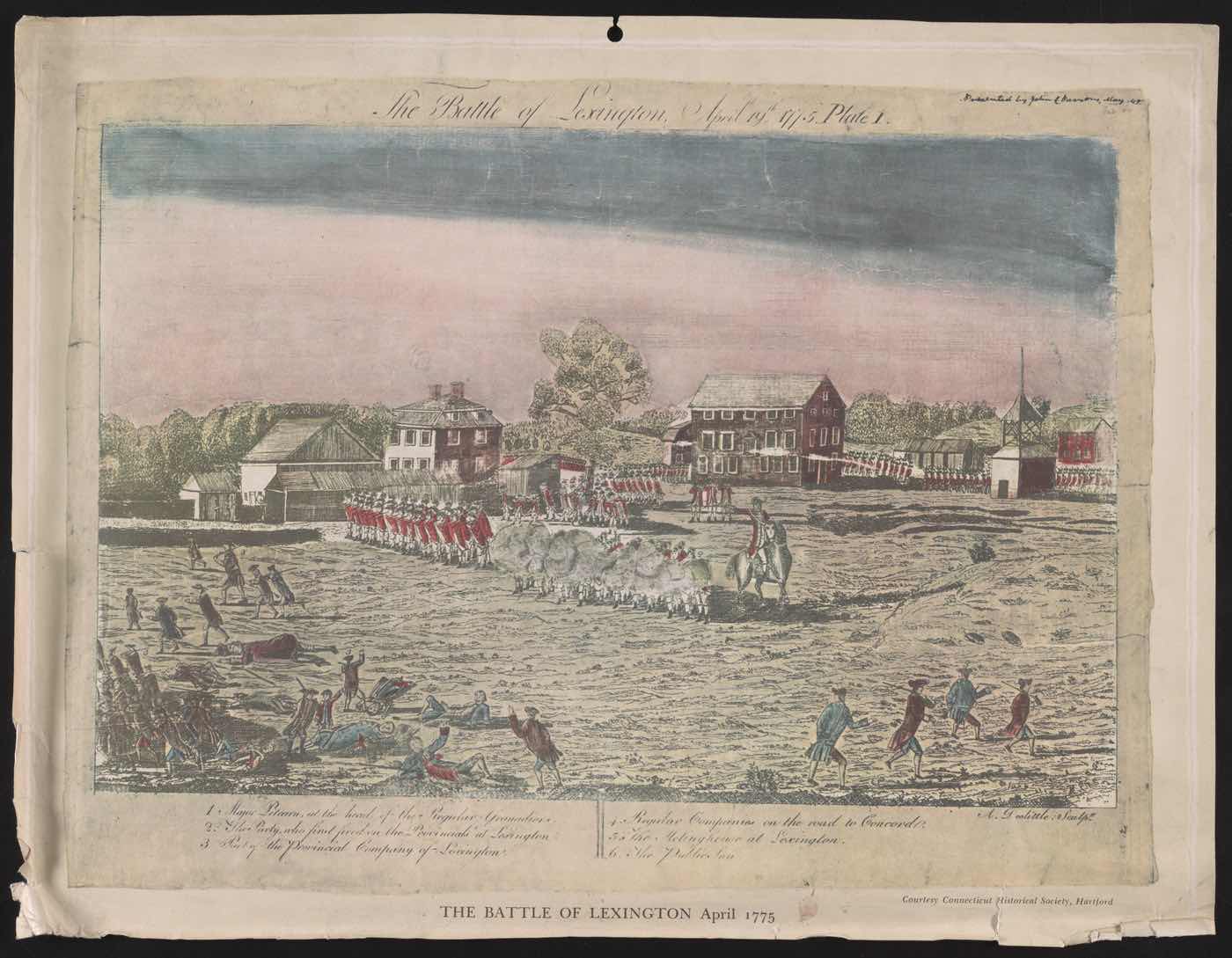
View the Study Pack on EtsyIn December 1775, a twenty-one-year-old New Haven engraver named Amos Doolittle published four copper-plate engravings of the Battles of Lexington and Concord. They are the only contemporary American images of April 19, 1775. Every activity below uses one or more of these engravings as its primary source.
The engravings are rough. Doolittle was a silversmith and self-taught engraver, not a trained artist. He visited the battle sites days after the fighting, interviewed witnesses, and worked from field sketches made by the painter Ralph Earl. What results is something closer to documentary evidence than fine art. That is precisely what makes them useful in a classroom.
Activity 1: "What Do You See?"
Grades 4-8. 15 minutes. Individual or paired.
Give students a print of Plate I (The Battle of Lexington) with no caption, title, or context. Ask them to list everything they observe: buildings, figures, formations, smoke, terrain. How many groups of people can they identify? What are the groups doing? Where is the open ground, and where are the structures? Only after students have recorded their observations should you provide the historical context. The goal is to separate looking from knowing. Students who begin with the answer tend to see what they expect. Students who begin with the image tend to notice what is actually there.
Activity 2: "Compare the Accounts"
Grades 5-8. 20 minutes. Paired or small group.
Provide students with Plate III (The Engagement at the North Bridge in Concord) alongside a short modern written account of the same event. A single paragraph from a textbook or encyclopedia entry will do. Ask: What details appear in the engraving that the written account does not mention? What does the written account describe that the engraving cannot show? Students should produce two lists. This exercise builds the habit of treating every source as partial. An engraving shows spatial relationships and physical details. A written account can convey sequence, motive, and sound. Neither is the whole story.
Activity 3: "Map the Retreat"
Grades 6-8. 20 minutes. Individual or paired.
Plate IV shows the British retreat from Concord toward Boston. The road is narrow. Stone walls and trees line the route. Colonial militia fire from behind cover while the British column moves in the open. Ask students to sketch a simple overhead map of the scene Doolittle depicts. Where are the British? Where are the militia? Why is the road a problem for the retreating column? Students should identify at least two reasons why guerrilla tactics were effective on this terrain. The retreat cost the British 73 dead, 174 wounded, and 53 missing. The landscape in the engraving helps explain why.
Teacher's Answer Key: Activity 3
Students should identify at least two of the following:
- The road is narrow and exposed. The British column cannot spread out or take cover.
- Stone walls and trees provide elevated firing positions for militia on both sides of the road.
- The column cannot maintain disciplined formation while moving and taking fire, which neutralises the British advantage in volley fire.
Activity 4: "The Engraver's Perspective"
Grades 6-8. 15 minutes. Discussion or written response.
Before examining the engravings further, give students three facts about Amos Doolittle: he was a New Haven militiaman, not a professional artist; he visited Lexington and Concord weeks after the battles, not during them; and he worked from another man's field sketches and witness interviews. Then ask: How might these facts affect what we see in the engravings? Is an image made weeks later from secondhand accounts the same as one made on the day? This is a sourcing exercise. Students practise evaluating a source before using it as evidence. The engravings are valuable precisely because students can articulate their limitations.
Activity 5: "Then and Now"
Grades 4-8. 15 minutes. Paired or whole class.
Display Doolittle's Plate I (Lexington Green, 1775) beside a modern photograph of the same location. The Lexington Green still exists. The Minuteman statue stands near where Captain Parker's militia formed. Ask students: What has changed between 1775 and today? What remains? Are there trees, buildings, or road features visible in both images? Students often assume the past is entirely gone. Comparing a primary source image with a modern photograph makes continuity visible. The green is still there. The meetinghouse is not.
About These Engravings
Amos Doolittle (1754-1832) published the four plates in December 1775 from his shop in New Haven, Connecticut. He engraved them from paintings by Ralph Earl, who had visited the battle sites with Doolittle in the weeks following April 19 and sketched the terrain from direct observation and witness testimony. The original copper plates are believed not to have survived. Impressions from the 1775 printing are held by several institutions, including the Connecticut Historical Society, the American Antiquarian Society, and the New York Public Library. The Library of Congress holds color halftone reproductions. Fewer than ten complete sets of originals are thought to survive. The engravings remain the only contemporary American visual record of the first day of the Revolutionary War.
Vocabulary for Students
| Engraver | A person who cuts a design into a metal plate, which is then inked and pressed onto paper to produce a print. |
| Copper plate | A flat piece of copper into which an image is cut with sharp tools. Used for printing before photography existed. |
| Militia | Ordinary citizens who trained as part-time soldiers and could be called up in an emergency. Not professional soldiers. |
| Primary source | A document, image, or object created at the time of the event it describes. Doolittle's engravings are primary sources. |
| Redoubt | A temporary defensive fortification, often made of earth and wood, built quickly on a battlefield. |
| Silversmith | A craftsman who works with silver to make objects like cups, spoons, and buckles. Doolittle's training in metalwork transferred to engraving. |
| Sourcing | In historical analysis, the practice of asking who made a source, when, why, and how those factors affect what it shows. |
America 250: Shop the Collection
Founding Portraits, Maps, and Historical Prints
Washington. Adams. Jefferson. Hamilton. Abigail Adams. The Siege of Boston. Museum-quality prints and canvas reproductions for walls that take history seriously.
Shop HeritageLabCo on Etsy