A Vote Taken in a Wooden Church
On the afternoon of Thursday, March 23, 1775, around 120 delegates met in St. John's Church on a hill above the James River in Richmond, Virginia. The Second Virginia Convention had moved there from Williamsburg after Lord Dunmore, the royal governor, grew aggressive and the capital grew thin on hospitality. St. John's was the largest building in the upper town, with plain pine pews and a chill in the March air. Yet the galleries overflowed with spectators who had ridden in to hear what the Convention would decide about arming the colony.
The motion on the floor was whether to raise and train a Virginia militia in preparation for a war with Britain that had not yet begun, but which seemed more and more likely. Many of the delegates opposed the measure, believing that arming at this stage committed the colony to a course of action from which there would be no retreat. Peyton Randolph, the Convention's president, and Edmund Pendleton, his most senior ally on procedural questions, both argued against it. Petition and conciliation, they said, still had time to work.
Patrick Henry stood to speak fourth or fifth in the day's sequence. He was thirty-eight years old, a lawyer with a circuit practice in the Piedmont country and a reputation for courtroom theatrics that had sometimes unsettled the Virginia bar. He had no prepared text, and spoke for only a few minutes. The witnesses who later described the events of that day agreed that he spoke with the force of a man who believed he was being overheard by posterity, and that when he finished the room held a silence before bursting into uproar. When Peyton Randolph called for the vote, the motion passed by a small margin. Estimates place it at 65 to 60; a shift of only three votes would have defeated it.
The Speech That Was Not Written Down
No one at the Convention wrote down what Patrick Henry said.
The printed version that every American schoolchild now encounters appeared in 1817, in William Wirt's Sketches of the Life and Character of Patrick Henry. Wirt was a Virginia lawyer, appointed Attorney General of the United States the same year the biography appeared. He had known Henry only briefly, late in Henry's life, and had never heard him give the speech. When he set about reconstructing it for the biography, he relied on correspondence and interviews with men who had been in St. John's that afternoon forty-two years earlier and were willing to describe what they remembered hearing.
The witnesses agreed on certain things: the speech was short, delivered with unusual force, and closed with a phrase about liberty and death. On the specific wording, the witnesses diverged, and Wirt made editorial choices that produced a sustained and quotable text where the underlying testimony was fragmentary.
"In vain should I attempt to give any idea of his speech."
Judge St. George Tucker, who was present at St. John's on March 23, 1775, writing to William Wirt in 1815.Tucker had been in the room. He was the only one of Wirt's correspondents who attempted an actual text, and even he put the effort down as futile. What he did manage to write out ran to less than a fifth of the speech that eventually appeared in the biography. Wirt thanked him for it and told him plainly what he had done: "I have taken almost entirely Mr. Henry's speech in the Convention of '75 from you, as well as your description of its effect on you verbatim." In other words, the fragmentary recollection of a single witness, elaborated by a biographer, is most of what we quote.
Thomas Jefferson, who knew Henry personally and had heard him speak in court and in the Burgesses, later described Henry's oratorical method as operating by effect rather than argument, capable of moving an audience past the point where reasoned objection could catch hold. Jefferson also observed, acidly, that Henry's recorded speeches did not read nearly as well as they had sounded in the room. This is consistent with the problem Wirt faced in 1817. The testimony was about what the speech had felt like, not what it had been.
What Wirt produced is, in fair description, a historical novel that won. It is the quotation we know. Whether it matches the words Henry actually said on March 23, 1775, is a different question, and the answer is almost certainly no.
"It is in vain, sir, to extenuate the matter. Gentlemen may cry, Peace, Peace, but there is no peace. The war is actually begun! The next gale that sweeps from the north will bring to our ears the clash of resounding arms. Our brethren are already in the field. Why stand we here idle? What is it that gentlemen wish? What would they have? Is life so dear, or peace so sweet, as to be purchased at the price of chains and slavery? Forbid it, Almighty God! I know not what course others may take; but as for me, give me liberty or give me death!"
The peroration as William Wirt published it in his 1817 biography. The version has held as the canonical text of American political oratory for two centuries.Read it as Wirt's language, not Henry's. It is the shape of the speech as reconstructed by a biographer, from the memories of old men, refined for print. The closing line is the only part most historians treat as probably authentic, or near enough. The rest is Wirt at the desk, sixty years after the room had emptied.
The Man in Homespun
Henry was tall and lean, with a pronounced Virginia accent. Edmund Randolph, later the first Attorney General of the United States, described Henry's oratory as matching Demosthenes in force, though not in polish. Henry wore homespun that day, part ostentation and part identification with the Piedmont yeoman farmers whose cause he claimed to carry. The rhetorical power was not in the voice alone. He used his body: the raised hands, the pause, the turn from the podium, the silence held a beat longer than felt comfortable.
He was arguing, specifically, for a resolution to put the colony into a posture of defense. The language was deliberately modest. A colony in a posture of defense is not necessarily a colony at war: but the delegates in the room understood what was being proposed. If Virginia armed, the other colonies would consider arming. Once enough of them did, Britain had to respond. The vote was not really about militias, but whether Virginia was willing to be the colony that acted first and tipped the continent's hand toward revolution.
Twenty-Seven Days
Between Henry's speech and the first exchange of fire at Lexington Green, twenty-seven days passed.
The Virginia Convention adjourned on March 27. Delegates rode back to their farms and practices with instructions to help organize local militias. George Washington, who had listened in St. John's and voted with Henry, went home to Mount Vernon to review the muster rolls of the Fairfax County militia he had been drilling since the autumn. The country waited.
On April 19, 1775, British regulars under Lieutenant Colonel Francis Smith marched to Concord, Massachusetts, to seize colonial military stores. Eight militiamen died on Lexington Green that morning. The running fight back to Boston cost the British seventy-three killed, one hundred seventy-four wounded, and twenty-six missing. Amos Doolittle, an unknown young silversmith in New Haven, would eventually travel to the battlefields and produce the only contemporary American images of that day.
On April 20, the day after Lexington, Lord Dunmore ordered Royal Marines to remove the colonial powder stored at the Williamsburg magazine. The move was calculated and, Dunmore hoped, quiet. It was neither. Henry responded by raising a militia company in Hanover County and marching on Williamsburg to demand restitution. He received it in the form of a promissory note for three hundred and thirty pounds, drawn on the colonial treasury, and a written record of the dispute that worked its way into every colonial newspaper. Henry had been right about the value of a colony in a posture of defense.
The Print in 1876
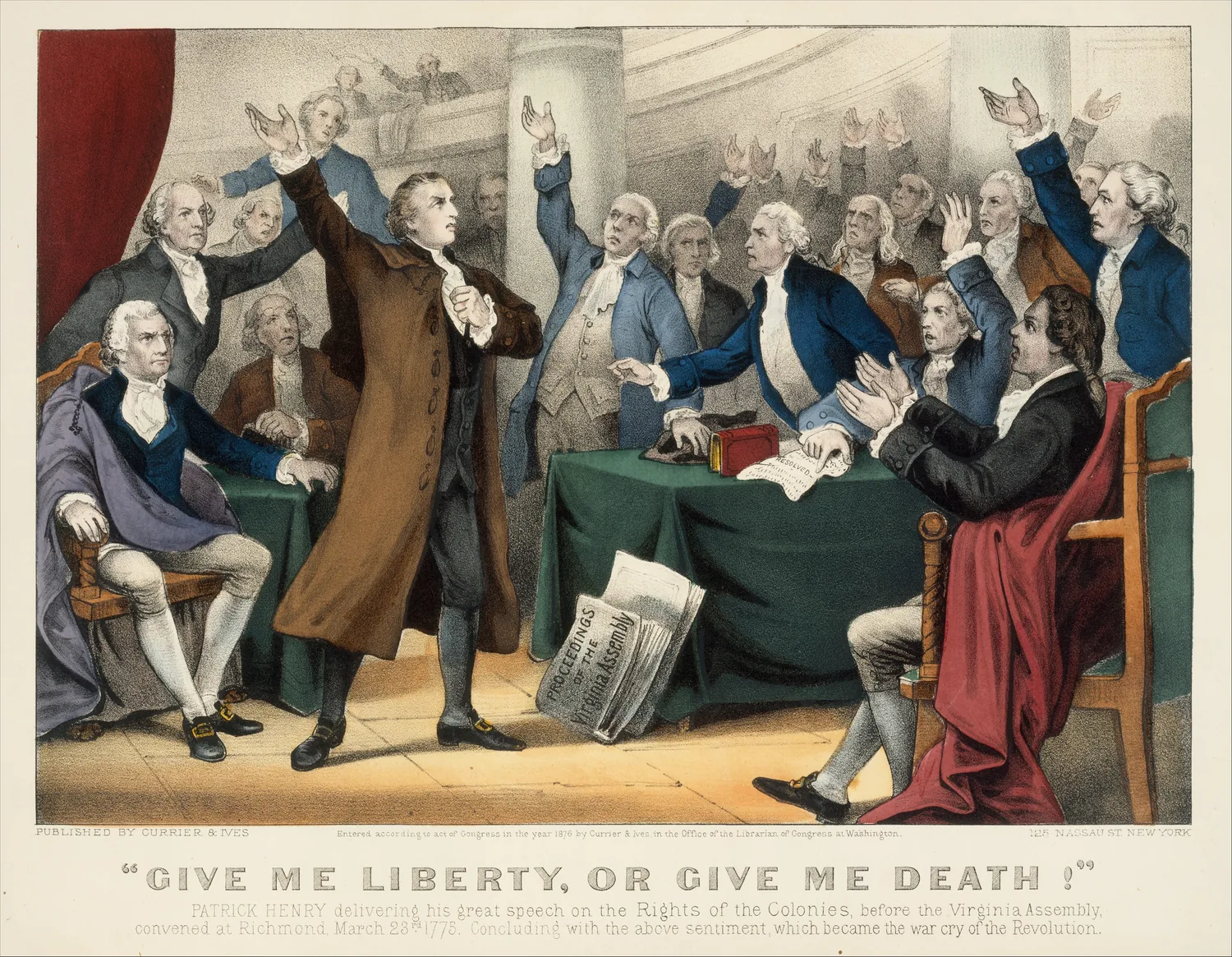
The image Heritage Lab offers as a digital print is a Currier and Ives lithograph issued around 1876, for the Centennial of the Declaration of Independence. It shows Henry on his feet, one arm thrown high, his head lifted, in the pose of a man who has just said something the room will remember.
Nothing about the print is contemporaneous. Currier and Ives had no portrait from the life of Henry at thirty-eight to work from, and no sketch of St. John's from 1775 that showed the delegates in their seats. The figures are invented, the coats, the cravats, the wigs on some of the older delegates, the spectacles on men reading documents in the foreground, are all 1876 imagining what 1775 looked like.
This is worth saying, because the print has been reproduced so often that it has drifted free of its origin. It is not a record of what Patrick Henry said, but a record of something different: the story Americans in 1876, one hundred years into the experiment, needed to tell themselves about what Patrick Henry had said. The foxing on the old impressions, the yellowed margins, the plate marks, are all part of a nineteenth-century object created to serve a nineteenth-century purpose. The Currier and Ives print tells us what the speech became, not what it was.
And that is, on reflection, the useful thing about it. The speech we know today was a reconstruction. The most recognizable image of the speech is a reconstruction of a reconstruction. The whole monument is built of remembered impressions, imagined crowd scenes, and rhetorical habits that have hardened into national myth. We quote Wirt's 1817 wording under a lithograph made nearly sixty years later for the Centennial. The only thing we can say with real confidence about March 23, 1775 is that something happened in St. John's Church that afternoon which caused sixty-five men to vote against their own instincts and for their own risky future.
And that, probably, is enough.
The Print, and What Goes with It
The Patrick Henry Give Me Liberty print is part of the Heritage Lab America 250 collection, which also includes the Doolittle plates from Lexington and Concord and the Thirteen Portraits study pack for the figures whose decisions shaped the war that followed. The Convention that heard Henry included George Washington, Thomas Jefferson, Peyton Randolph, Edmund Pendleton, and Richard Henry Lee. Several of them appear as individual prints in the Founders rail on the Heritage Lab home page.
If you teach the Revolution, the richest question to ask with students is not what Patrick Henry said. It is who was in the room, what they were being asked to vote for, what they had to lose, and what they did anyway. The speech was always secondary to the vote.