America 250 Collection
Primary Sources for Charlotte Mason Picture Study
Founding portraits, battle engravings, and historical maps. Museum-quality prints with narration prompts and educator guides for morning time and picture study.
Browse the Collection on EtsyKing Street, Half Past Nine
On the evening of March 5, 1770, a crowd gathered outside the Custom House on King Street in Boston. Accounts differ on the sequence, but the essential facts are not in dispute: British soldiers of the 29th Regiment fired into the crowd, and five colonists died. The first was Crispus Attucks, a man of African and Wampanoag descent who worked on whaling vessels out of Boston harbour. Samuel Gray, James Caldwell, and Samuel Maverick died that night or within hours. Patrick Carr lingered for nine days before succumbing to his wounds.
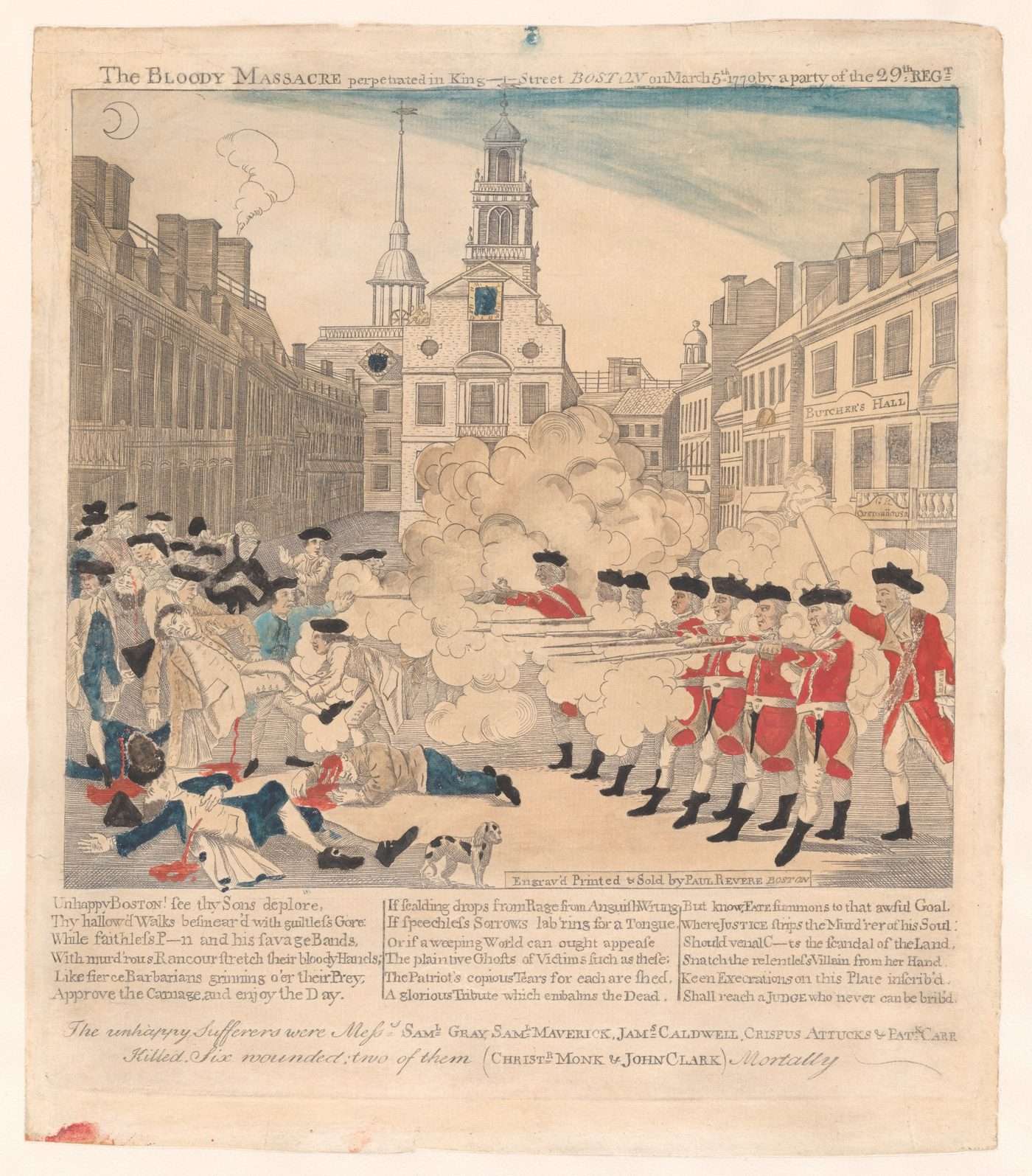
Within three weeks, an engraving was on sale in Boston. Paul Revere, a silversmith and copperplate engraver, had produced a hand-colored print depicting the event. It was not the first image of the shooting; it was the first to reach the public. It sold briskly. It was copied, reprinted, and distributed throughout the colonies. It remains the single most reproduced image of the pre-Revolutionary period. It is also, in nearly every important detail, a lie.
A Line of Redcoats on a Clear Afternoon
The engraving shows a rank of British soldiers in uniform red coats, muskets levelled, firing in unison at close range into a group of unarmed civilians. An officer stands behind the soldiers with his sword raised, as though giving the command. The civilians fall or stagger backward; one lies bleeding on the ground. The sky above is a clear, pale blue. The Custom House bears a sign reading "Butcher's Hall." A small dog sits calmly in the foreground.
The composition reads as a planned military execution: soldiers in formation, commanded by an officer, firing a disciplined volley into a peaceful crowd. That reading is the entire point. Revere was not attempting a faithful record of what happened on King Street. He was constructing the version of events most useful to the Patriot cause. Every element of the print serves that argument: the ordered soldiers, the passive crowd, the officer's raised sword, the clear daylight that makes the scene legible and undeniable.
Pelham's Design, Revere's Publication
The original design for this engraving was the work of Henry Pelham, a young Boston artist and half-brother of the painter John Singleton Copley. Pelham drew his version of the scene and prepared a copper plate. Revere saw the design, copied it closely, and published his own version first. Pelham was furious. He wrote Revere a letter accusing him of stealing the design, calling the act dishonourable and beneath any person who had the least regard for the dictates of honour and justice. The letter survives in the collections of the Massachusetts Historical Society and the accusation was never satisfactorily answered.
The question of plagiarism, while significant, is secondary to the question of accuracy. The inaccuracies in the engraving are systematic and deliberate. The soldiers appear as a disciplined line firing on command; contemporary testimony from both sides describes a chaotic confrontation in which individual soldiers fired under pressure from a hostile crowd. The sky is clear and light; the event took place after nine o'clock on a winter evening, in darkness. The crowd appears passive, unarmed, and startled; multiple witnesses, including some sympathetic to the colonists, described the crowd as aggressive, throwing snowballs, ice, oyster shells, and shouting at the soldiers to fire. The sign reading "Butcher's Hall" was Revere's invention; no such sign hung on the Custom House.
Revere knew what he was doing. He was a skilled engraver accustomed to working from reference and producing images for public consumption. The inaccuracies are not errors of haste or incompetence. They are editorial choices in the service of a political argument: that the British military had carried out an unprovoked massacre of peaceable colonists. Within weeks the print had achieved what no pamphlet or sermon could. It gave the colonies a picture of tyranny, and pictures travel faster than arguments.
Conducting the Picture Study
Charlotte Mason's method of picture study is observation followed by narration. The child looks at an image in silence, without commentary from the parent or teacher, and then describes what they remember. The method works because the effort of putting visual detail into words requires sustained attention, and sustained attention is the precondition for genuine understanding.
For this engraving, the method is particularly well suited, because the propaganda only becomes visible through close looking. A child who has observed the image carefully and narrated what they saw is already prepared to hear that the event took place at night, that the crowd was not passive, and that the artist copied someone else's work. The discrepancies between the image and the historical record are not supplementary information. They are the lesson.
Show the engraving for three to four minutes without commentary. Remove or cover the image. Ask the child to narrate everything they remember seeing. Then, once the narration is complete, provide the historical context outlined in this article and return to the image for a second look.
Narration Prompts
- Describe the soldiers. How are they standing? What are they doing? Does the scene look orderly or chaotic?
- Look at the people on the right side of the image. What are they doing with their hands? Do they appear threatening, frightened, or something else?
- What time of day does this scene appear to be? What in the image tells you that? (After the child answers, explain that the actual event took place at night.)
- There is a sign on the building behind the soldiers that reads "Butcher's Hall." The real building had no such sign. Why do you think the artist added it?
- If you were Paul Revere and you wanted people in other colonies to feel angry about what happened in Boston, how would you change the picture to make it more effective? Did he already make some of those changes?
The fifth prompt is the important one. It asks the child to think like a propagandist, which is the only reliable way to recognise propaganda.
Six Things Worth Noticing
| Attribute | What to Observe | Why It Matters |
|---|---|---|
| Composition | Soldiers on the left in a tight rank; civilians on the right, falling and recoiling. The two groups face each other across a clear space. | The composition divides the image into aggressor and victim. In reality there was no clear separation; soldiers and crowd were pressed together in the street. |
| Color | The soldiers' coats are a vivid red against the pale buildings and blue sky. Blood appears bright on the ground and on the victims' clothing. | Hand-coloring allowed Revere (or his colorists) to direct attention. The red coats and red blood create a visual argument: these soldiers are responsible for this blood. |
| The Soldiers | Seven or eight soldiers stand in a disciplined firing line, muskets at the same angle. An officer behind them raises a sword. | The ordered line implies a deliberate volley on command. Trial testimony, including testimony from Captain Thomas Preston himself, describes confused individual shots fired under duress. |
| The Crowd | The colonists appear unarmed and startled. Several hold their arms up or reach toward the fallen. No one is throwing anything. | Witness depositions describe the crowd hurling snowballs packed with ice, oyster shells, and sticks. Some were armed with clubs. Revere removed every trace of aggression from the colonial side. |
| The Sky | A clear blue sky, suggesting midday or early afternoon. Buildings and figures cast no strong shadows. | The shooting occurred after 9 p.m. on a March evening. Darkness would have obscured the scene and made the image less legible, less reproducible, and less useful as propaganda. |
| "Butcher's Hall" | A sign reading "Butcher's Hall" hangs above the soldiers, mounted on the Custom House wall. | No such sign existed. Revere added it to label the building, and by extension the soldiers and their government, as butchers. It is the least subtle element in the print and the most revealing of his intent. |
Compare: Revere's Copy and Pelham's Original
Henry Pelham's original design, titled The Fruits of Arbitrary Power, or The Bloody Massacre, reached the public after Revere's version was already selling. The two prints are nearly identical in composition, which is the evidence for the copying. But look carefully and the differences emerge: Pelham's version is slightly more refined in its line work, and certain details of the buildings and figures differ.
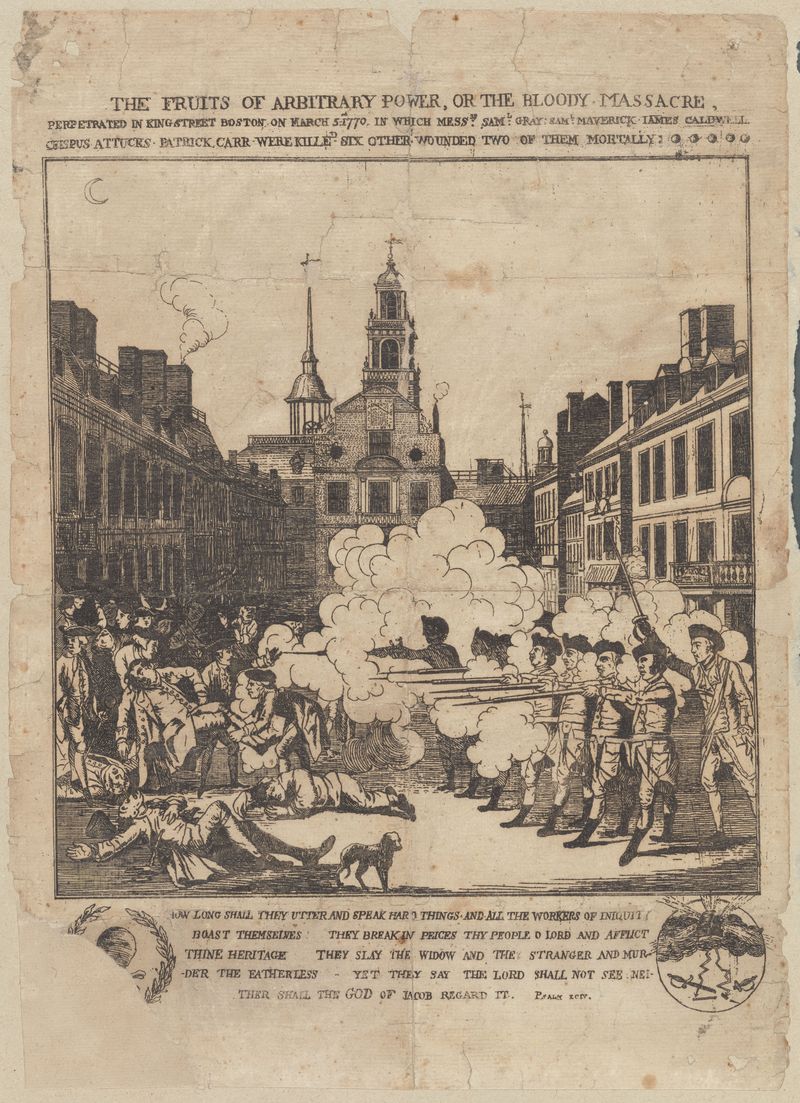
For a picture study exercise, show both images side by side and ask: What is the same? What is different? Which was made first? Why does it matter? Students who compare the two prints are doing exactly the kind of critical visual analysis that makes primary sources worth studying.
CC Cycle 3 Alignment
For families following the Classical Conversations Foundations cycle, this image aligns approximately with Cycle 3 coverage of pre-Revolutionary colonial tensions. The Boston Massacre (1770) is one of the key events leading to the Declaration of Independence five years later. We recommend verifying the specific week alignment against your Foundations Guide. See our CC Cycle 3 resource page for more.
About This Image
Paul Revere Jr., The Bloody Massacre perpetrated in King Street Boston on March 5th 1770 by a party of the 29th Regt., hand-colored engraving on paper, 1770. Based on a design by Henry Pelham. Multiple institutional holdings include the Museum of Fine Arts, Boston; the American Antiquarian Society, Worcester, Massachusetts; the Library of Congress; and the Metropolitan Museum of Art, New York. Surviving impressions vary in coloring, as each was hand-colored individually, often by different hands. The image is in the public domain in the United States.
The America 250 Collection
Heritage Lab's America 250 Collection brings the primary sources of the founding era into your morning time. Museum-quality prints, digital study packs, and educator guides built for Charlotte Mason picture study, CC Cycle 3, and hands-on history. The Revolution, seen through the images that shaped it.