March 5, 1776
The British woke on March 5, 1776, to find that Washington's army had fortified Dorchester Heights overnight. The promontory south of Boston, which looked directly down onto the harbor and the town, had been unoccupied and undefended for nine months; now it held artillery. General William Howe, who had inherited the Boston command from Thomas Gage the previous October, is reported to have said, with some feeling, that the rebels had done more in one night than his whole army could have done in months.
What made that single night possible was the work of the previous ten weeks: 59 pieces of artillery hauled roughly 300 miles through the Berkshires in January and February, across frozen lake ice that broke under the weight, through mountain passes where the roads were not roads and the snow was sometimes four feet deep, arriving at Cambridge on January 25, 1776, to a Continental Army that had been sitting outside Boston since June with virtually no heavy ordnance at all. The man responsible was 25 years old and had never commanded anything larger than a militia company. His name was Henry Knox, and before the war he had run a bookshop.
The Town at the End of a Neck
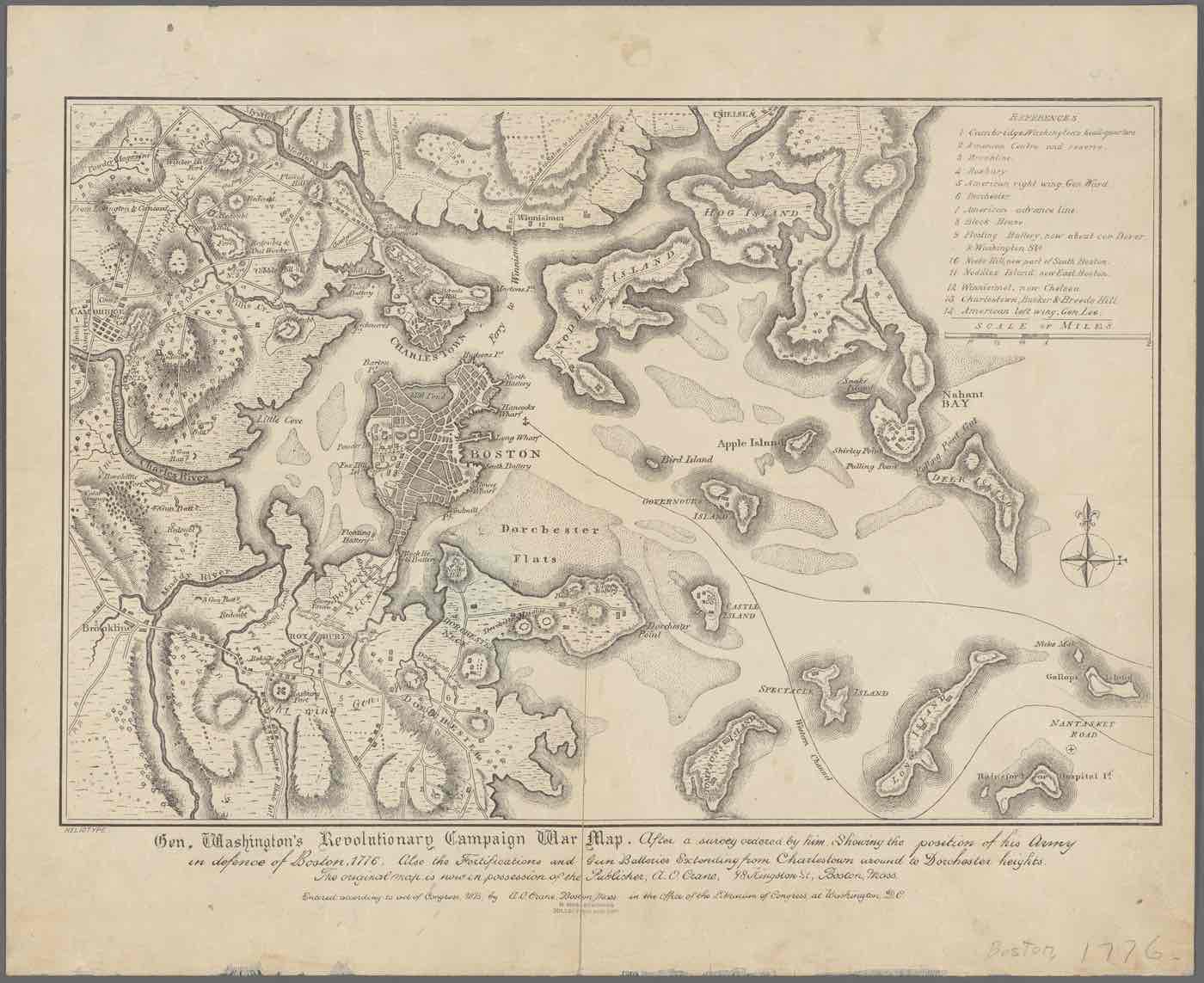
The map makes the geometry of the siege immediately legible. Boston sits on a near-island, connected to the mainland only by a narrow neck of land to the south, with the Charles River to the north and west and the harbor opening to the east. Charlestown is the peninsula to the north, Bunker Hill and Breed's Hill still marked from the fighting the previous June; Dorchester Flats and the promontory of Dorchester Heights occupy the lower right of the composition, separated from the town by water. The colonial positions are marked on the surrounding hills, a half-circle of occupied ground looking inward at a British garrison that could be supplied and reinforced by sea but could not break out by land without forcing one of those held positions.
Washington arrived to take command in July 1775 and found the situation exactly as the map describes it: a siege without the means to force a conclusion. The Continental Army held the surrounding heights and could prevent the British from advancing, but they had no artillery heavy enough to make the harbor untenable or the town indefensible. The British could sit and wait. So, for nine months, could Washington, though he found it considerably less agreeable.
"I hope in sixteen or seventeen days to present your Excellency with a noble train of artillery."
Henry Knox, letter to Washington, December 17, 1775 (Knox Papers, Massachusetts Historical Society)The Man Who Read His Way to an Army
Knox had grown up in Boston, the son of a shipmaster who died young and left the family in straitened circumstances; Knox left school at twelve to work in a bookseller's shop and, by the time he was twenty-one, had saved enough to open his own, which he called The London Book Store and stocked with military history, fortification manuals, and technical treatises, the genres that interested him most. He had read widely in artillery and siege warfare, in the campaigns of Frederick the Great and in the engineering texts of Vauban, and when the war started he had the theoretical knowledge of someone who has spent years reading about the subject and no practical experience at all.
Washington commissioned him Colonel of the Continental Regiment of Artillery in November 1775, a title without artillery to match it, and gave him an assignment that would have seemed impractical to almost anyone assessing it on a map: travel to Fort Ticonderoga on Lake Champlain, where Ethan Allen and the Green Mountain Boys had captured an intact British garrison in May, and bring back whatever artillery they had left.
Three Hundred Miles in Winter
Knox arrived at Ticonderoga in December and inventoried what was there: 59 usable pieces, including 18-pound and 24-pound cannon, mortars, and howitzers, along with a quantity of shot and flint. The total weight ran to something over 119,000 pounds. He had them loaded onto flatboats, crossed Lake George, and began the overland haul south through the Berkshires to the Hudson Valley and then east toward Boston, using oxen and horses and improvised sledges cut from local timber.
Lake George froze behind him as he crossed, which was fortunate; in January the ice broke under the weight of one of the cannon, and Knox's men retrieved it from the lake bottom before it was lost. The Berkshire passes were the worst of it, the sledges requiring constant repair, the roads disappearing entirely in some stretches, local farmers hired to help and then replaced by the next set of local farmers as the column moved east. Knox wrote to Washington from Fort George on December 17 with his estimate of sixteen or seventeen days; he arrived at Cambridge on January 25, five weeks later, with the full complement of ordnance.
Washington inspected the train and immediately began planning its use. Dorchester Heights was the obvious position: elevated, unoccupied, with a clear line of fire across the harbor to the British fleet and into the town itself. The problem was that entrenching in winter ground, frozen solid, would take days and require enormous labor with no cover from British observation. Knox's solution, drawn from his reading on field fortification, was to prefabricate the defensive works in sections and assemble them overnight, filling the frames with hay bales that would absorb musket fire and provide insulation from the cold.
What the Loyalists Left Behind
On the night of March 4, 1776, some 2,000 men carried the prefabricated frames and the hay bales up Dorchester Heights under cover of darkness, while a diversionary bombardment kept British attention focused on the Cambridge lines. By dawn the position was fortified and the artillery was in place, and Howe, looking up from the harbor, concluded that he could not take the heights without casualties on the scale of Breed's Hill; he had no appetite for that. He requested a truce and began organizing his evacuation.
On March 17, 1776, roughly 8,000 British soldiers and 1,100 Loyalist civilians sailed out of Boston Harbor for Halifax. Among the Loyalists was Thomas Flucker, the Royal Secretary of the Province of Massachusetts, who had been one of the most senior Crown officials in New England; he evacuated with his wife and whatever they could carry, sailed to Halifax, and eventually made his way to England, where he died in 1783 without returning. His daughter Lucy had married Henry Knox in 1774, over his vigorous objection, and Knox's cannon had now driven his own father-in-law into permanent exile. The record does not preserve Knox's comment on this, if he made one.
Evacuation Day, March 17, is still a legal holiday in Suffolk County, Massachusetts.
The Centennial Map
The NYPL engraving was made in 1875, a century after the events it describes. It is not a contemporary document but a cartographic reconstruction: drawn, as its full title states, "after a survey ordered by him," meaning Washington commissioned the original survey of his own positions during the siege, and the 1875 engravers worked from that record to produce this map for the centennial generation. The geometry is therefore authoritative -- derived from Washington's own military survey -- but the hand producing it belonged to the Victorian era, not the Revolutionary one.
That distinction is visible in the linework. The fine crosshatching on the water, the careful stipple of the hills, the clean legend in the upper right: this is the precision of a professional 19th-century engraver working from historical documents, not a field cartographer sketching under pressure. What it shows, however, is the real problem: Boston surrounded by water, the heights commanding the harbor, the colonial positions on the surrounding hills looking inward at a garrison that could be supplied by sea but could not break out by land. Knox gave Washington the artillery to resolve that geometry, and the map -- made a hundred years later, from Washington's own survey -- records the ground as he found it.
Timeline of the Siege: June 1775 to March 1776
The siege lasted eleven months. Washington inherited it when he arrived in Cambridge on July 2, 1775, and ended it when Knox's cannon forced the British evacuation in March 1776.
| Date | Event |
|---|---|
| Apr 19, 1775 | Lexington and Concord. Massachusetts militia surrounds Boston. |
| Jun 17, 1775 | Battle of Bunker Hill. British take the peninsula at devastating cost (1,054 casualties). |
| Jul 2, 1775 | Washington arrives at Cambridge (formally takes command July 3). |
| Jul-Oct 1775 | Stalemate. Washington reorganizes the militia into a disciplined force. Chronic shortage of gunpowder. |
| Nov 1775 | Knox proposes hauling cannon from Fort Ticonderoga (captured by Allen and Arnold in May). |
| Dec 1775 - Jan 1776 | Knox's train: 60 tons of artillery dragged 300 miles across frozen rivers and mountains. |
| Jan 24, 1776 | Knox arrives at Cambridge with the cannon. Washington now has the firepower to threaten Boston. |
| Mar 4, 1776 | Overnight fortification of Dorchester Heights. Knox's cannon aimed down at Boston and the harbor. |
| Mar 17, 1776 | British evacuate Boston. Howe sails for Halifax with 9,000 troops and 1,000 loyalist civilians. |
Sources: McCullough, 1776 (2005); Philbrick, Bunker Hill (2013).